Xi Wangmu’s Birthday – April 19 (3rd Moon, Day 3)
Apr 18, 2026Xi Wangmu (also known as the Queen Mother of the West) is a profoundly important figure in Taoist philosophy and Taoism, and actually predates Lao Tzu and organized Taoism itself. Xi Wangmu is a remnant of an earlier matrilineal society in ancient China. Before the big three teachings (Taoism, Buddhism, Confucianism), ancient China was dominated by Wuism (shamanism).
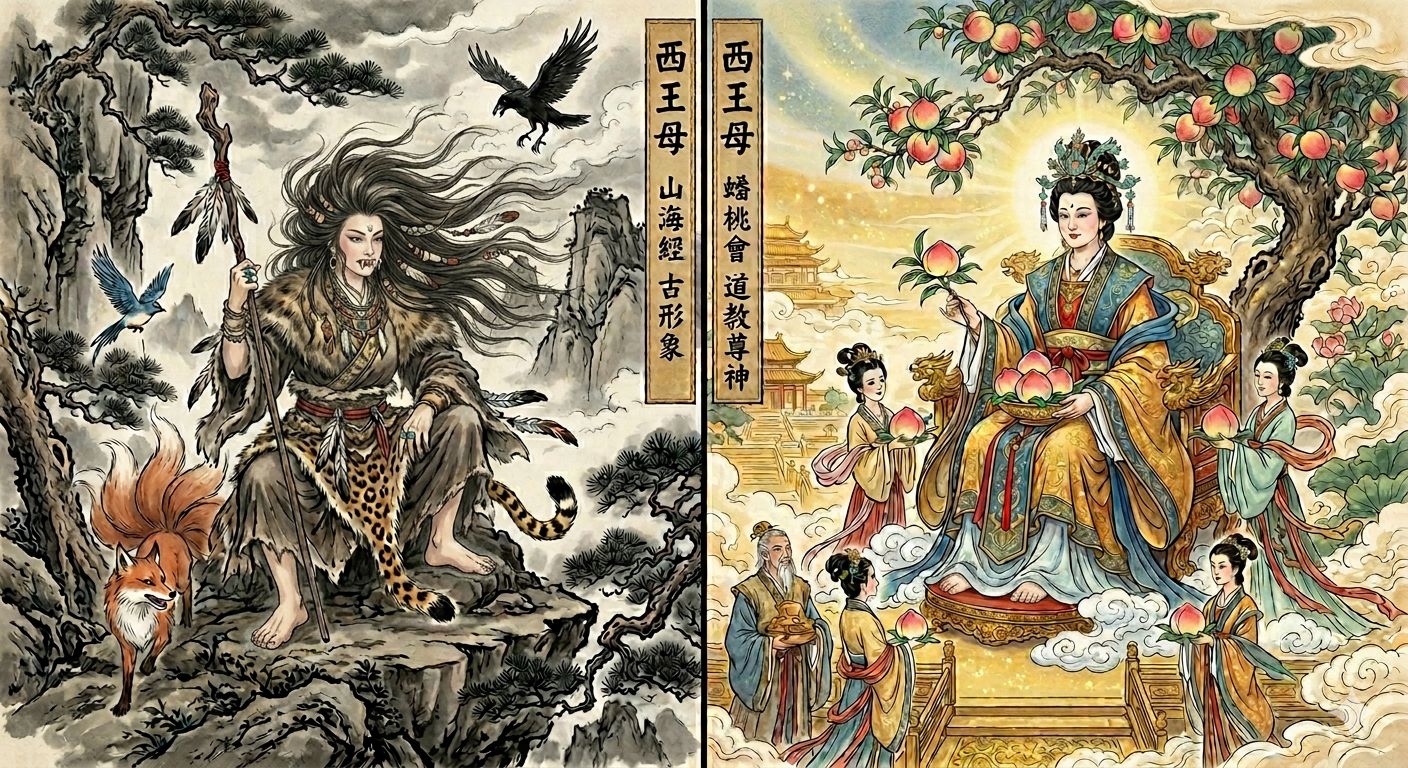
Xi Wangmu appears in the Shanhaijing (Classic of Mountains and Seas), a text compiled in the 4th century BCE but containing much older oral traditions dating back to 2000 BCE and possibly older. Here, she is depicted as feral, having the teeth of a tiger, the tail of a leopard, wearing a crown, and sitting on a mountain in the wild west. She represents the boundary between the human world and the wild. A Master of Calamity, she presides over the “Constellations of the Great Calamity” and “Five Destructive Forces.”
In the earliest shamanic periods of Chinese culture, being associated with wildness, death, and disease wasn't an “evil” trait; it was a power trait. If a deity had the power to send a plague, they also had the power to stop it. Xi Wangmu was seen as the arbiter of the "Five Destructive Forces." Long before Taoism was a defined label, there existed a "Way" of aligning with nature and cosmic cycles. This was, in essence, Taoism, before it was given a name and organized. Xi Wangmu embodied the primal, chaotic, and fertile aspects of nature. She was the “Mother” because she was the source of life and the return-point of death, a concept very much in line with the Tao De Jing’s description of the Tao as the “Great Mother.” In the Tao De Jing, Lao Tzu often refers to “the masters of antiquity.” These figures are the very same characters who followed the Way of nature and whose legends are detailed in the Shanhaijing, often seen as the original practitioners of the Tao. Many of the Shanhaijing’s themes, such as the sacredness of nature, later became core pillars of Taoism.
“The valley spirit never dies; it is called the Mysterious Female. The gateway of the Mysterious Female is called the root of Heaven and Earth.”
—Tao De Jing
Early Taoist thought viewed Yin not as “bad,” but as the primordial source. Yin is the valley, the womb, and the dark earth. While Yang is activity and light, Yin is the necessary stillness and the return to the root. Because the movement of Yin is returning (whereas Yang springs forth), it is said to be closer to the Tao. Xi Wangmu’s earliest records show her as autonomous. She exists before the Jade Emperor and before the formal Taoist heavens were mapped out. Her title, Mu (Mother), suggests she was the head of a divine lineage that didn’t require a male counterpart to justify her authority.
Xi Wangmu’s “wild” features, the leopard tail and tiger teeth, are classic shamanic markers. They suggest a “Master of Animals” figure, a role almost always held by the central spiritual authority in matrilineal tribal societies. Historical records and archaeological finds show a high prevalence of female shamans and female-centered figurines.
As Taoism began to coalesce, Xi Wangmu was “tamed” in depiction and was portrayed as a powerful cosmic mother who holds the secret to immortality. She is the one who possesses the Elixir of Immortality, symbolized by her peaches that grant immortality to those she offers them to. She became the supreme goddess of the Kunlun Mountains, the axis mundi (center of the world). Early Taoist sects (like Shangqing) saw Xi Wangmu as a teacher and superior to Lao Tzu.
In much later depictions with Confucianism, and as China became more patriarchal, she is presented as a refined Queen in a palace, dressed in scholar-official robes, and eventually “married” off to Dongwanggong (and in later times to the Jade Emperor) to fit the state-sanctioned family model (The Royal Consort), though she historically remained the more significant and ancient figure of the two.
In Han dynasty tombs, Xi Wangmu is often depicted sitting on a throne, while Dongwanggong is tucked away in a corner or absent entirely. This suggests that even as society became patriarchal, the spiritual psyche of the people still recognized the feminine as the primary holder of the “Elixir of Life.”
The evolution of Xi Wangmu can be understood as a reflection of China’s social development. Scholars in the fields of Sinology and Taoist studies point to key evidence suggesting that Xi Wangmu may be a remnant of an ancient Chinese matriarchal society. This perspective highlights her as a powerful cultural figure whose mythological status may originate from a historical, possibly shamanic, individual.
For those interested in exploring this topic further, several leading scholars have made significant contributions. Notable heavyweights in the field include Kristofer Schipper, who often referred to Xi Wangmu’s era as “Real China” or “Other China”; Edward H. Schafer, a historian and expert on the Tang dynasty; Michael Loewe, known for his focus on archaeological evidence; Kominami Ichirō, who conducted extensive research on the subject; and Suzanne Cahill, who specializes in the study of Xi Wangmu.
Sign up for our mailing list!
Get monthly newsletters, updates, and Taoist cultivation resources delivered to your inbox.
We will never sell your information.
