The Eight Immortals
Sep 13, 2026The Eight Immortals are a group of legendary figures in Taoist lore, some of whom appear to have been actual historical people. They were not originally a unified group, however. Those who can be connected to historical figures lived during different periods, long before later traditions brought them together as the Eight Immortals.
Within Taoist tradition, immortality can be understood as more than simply living forever. It can represent alignment with the Tao—the attainment of mental freedom, physical fluidity, self-mastery, and effortless action.
The Eight Immortals do not function merely as gods to be worshiped. They can also be understood as archetypes, psychological metaphors, and philosophical allegories. Together, they represent a broad spectrum of human existence, with each figure possessing a different character and background: male and female, old and young, rich and poor, noble and humble. In this way, they reflect principles of Yin and Yang, balance, and the transcendence of ordinary distinctions. The Tao does not favor the elite, the educated, or the ascetic. Transcendence can arise from any condition of life—whether one is a beggar, an old hermit, or a court noble.
The Eight Immortals are also celebrated for their human qualities, earthly flaws, and accessibility to ordinary people. Each Immortal carries a distinctive object or emblem. Collectively, these objects are known as the “Covert Eight Immortals” and are traditionally associated with particular powers and attributes. Rather than viewing them only as literal magical objects, however, they can also be interpreted as symbols of self-cultivation, Internal Alchemy (Neidan), and particular qualities or states of mind.
The Eight Immortals are:
Lü Dongbin represents intellectual and spiritual clarity. He carries a sword that can be understood as cutting through attachment, ego, and mental illusion.
Zhang Guolao represents paradox and reversal. He is famously depicted riding a donkey backward, reflecting the Taoist principle that “reversal is the movement of the Tao.” What appears to be retreat may sometimes be the true path of progress.
Li Tieguai represents transcendence of outward form. According to legend, his spirit temporarily left his body, only for him to return and discover that his original body had been burned. He was therefore forced to inhabit the body of a disabled beggar. His story suggests that one's true nature is not determined by physical beauty, appearance, or bodily status.
Zhongli Quan represents transformation and Qi. His feather fan is associated with transformation and can also be interpreted as representing the gentle, persistent cultivation needed to clear stagnation and transform internal energy.
Lan Caihe represents spontaneity and freedom from social convention. Dressed eccentrically and singing without concern for wealth, status, or reputation, Lan Caihe evokes the free-spirited wanderer found throughout the writings of Zhuangzi.
He Xiangu, the only woman traditionally included among the Eight, represents purity and nourishment. The lotus she carries symbolizes the ability to remain unpolluted even while rooted in the mud of the mundane world, while also expressing the quiet and nourishing qualities of Yin.
Han Xiangzi represents harmony with nature. His flute can be associated with the “Music of Heaven” described by Zhuangzi—the ability to live in harmony with the spontaneous movements of nature rather than continually attempting to force outcomes.
Cao Guojiu represents detachment from status and power. A member of the royal court who abandoned courtly life for self-cultivation, he symbolizes the rejection of political ambition and social vanity. The tablet he carries also connects him with law, order, protection, and proper governance.
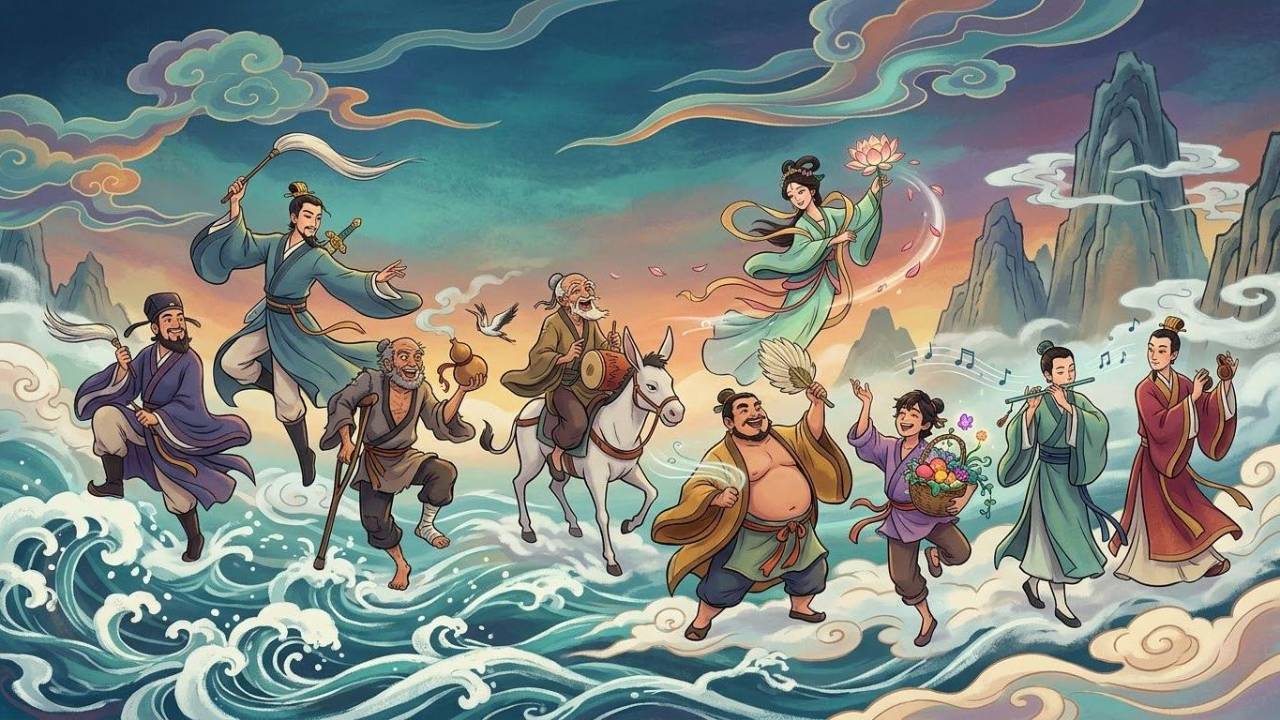
One of the most famous legends associated with the group is the Eight Immortals Crossing the Sea. In the story, rather than relying on a boat, each Immortal uses his or her own unique object or ability to cross the turbulent waters of the East China Sea.
The sea can be interpreted as the chaotic and unpredictable nature of life and the mundane world, while the objects carried by the Immortals represent the unique qualities and abilities possessed by each individual. Rather than everyone crossing the sea in the same way, each Immortal finds a way across according to his or her own nature.
The deeper lesson is not that we should reject all external institutions or conventions, but that we cannot navigate the uncertainties of life by relying on them alone. We must discover, cultivate, and learn how to use our own innate qualities. Instead of continually fighting against the currents of life, we learn how to recognize them, adapt to them, and move with them.
The Eight Immortals ultimately present a remarkably inclusive image of Taoist cultivation. They come from different circumstances, social positions, personalities, and ways of life, yet each finds a path toward transcendence. Their stories suggest that no single outward condition determines who can follow the Tao. Anyone, regardless of status or background, can see something of themselves reflected among the Eight Immortals.
—Suzanne Nosko
Sign up for our mailing list!
Get monthly newsletters, updates, and Taoist cultivation resources delivered to your inbox.
We will never sell your information.
