The Double Sevens Festival
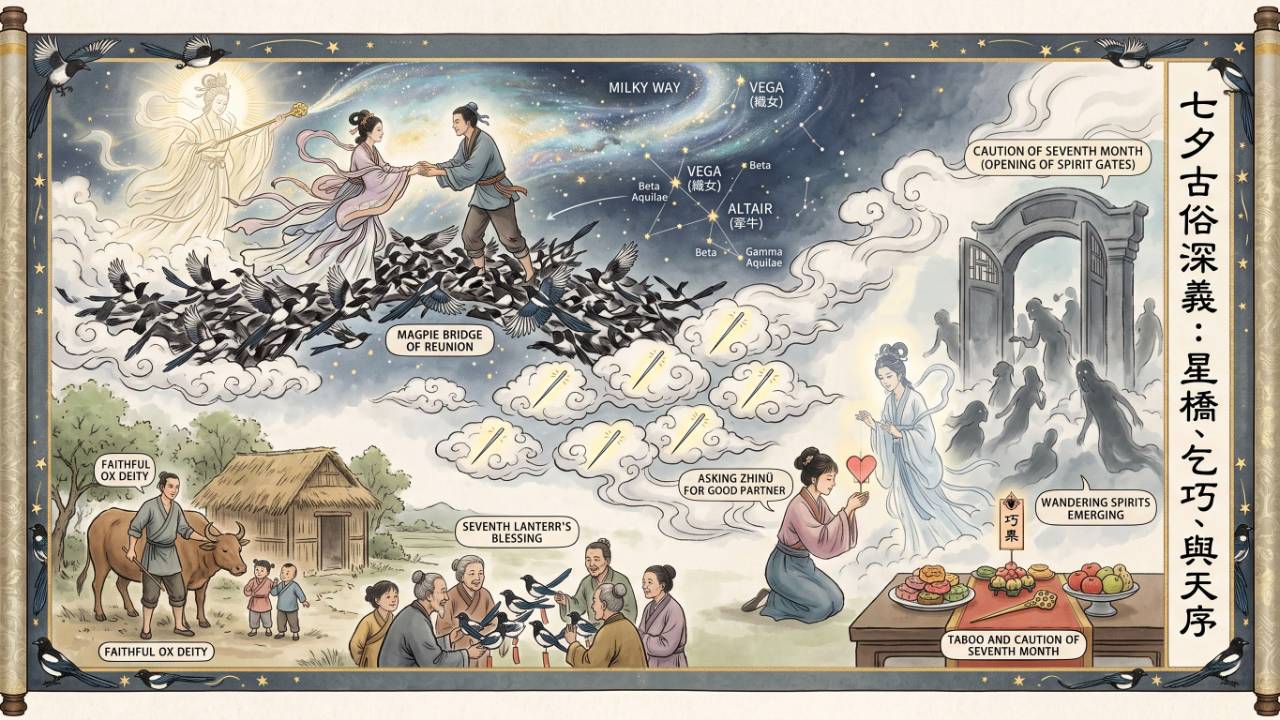
Aug 13, 2026On the 7th day of the 7th month of the Chinese lunar calendar, the Double Sevens Festival (also known as the Qixi Festival) is celebrated. The Qixi Festival is primarily a traditional Chinese folk and astronomical festival rather than an exclusively Taoist holiday. However, because Chinese folklore and Taoism often overlap, Taoism integrated several elements of the holiday over time. The festival originated from early astronomical observations. Ancient Chinese stargazers observed two bright stars positioned on opposite sides of the Milky Way: Vega (in the constellation Lyra) and Altair (in Aquila).
On the night of the 7th day of the 7th month, the story honors Zhinü (the Weaver Fairy/star Vega) and Kuixing (the figure presiding over examinations and literature, whose birthday is traditionally celebrated/star Altair). To explain this cosmic setup, a folk myth was born. The Lovers: Zhinü (the Weaver Girl), a celestial fairy who wove clouds, fell in love with Niulang (the Cowherd), a mortal man. They married and had two children, but the celestial heavens forbade mortal-immortal unions. The Queen Mother of the West dragged Zhinü back to heaven and scratched a wide, raging river across the sky with her hairpin, creating the Milky Way, to keep them apart forever.
Touched by the devotion of the family, all the magpies on Earth were moved to fly up into the sky and form a Magpie Bridge across the Milky Way. Moved by this sight, the heavens allowed the couple to meet on that bridge just once every year, on the 7th night of the 7th lunar month.
In Chinese tradition, it is believed that on the first day of the 7th lunar month, the gates of the underworld open, releasing restless spirits and ancestors into the world of the living for a month-long “vacation.” Because the entire 7th month is filled with wandering ghosts, people traditionally avoid major life milestones during this time, such as getting married, buying a home, or starting a business, out of fear of attracting bad luck.
The number seven itself is heavily tied to traditional Chinese practices. In Chinese death customs, the spirit of the deceased remains on Earth for 49 days (The 49-day mourning period (7×7)). Rituals are performed by the family every 7 days, known as “Doing the Sevens,” to help guide the deceased into the afterlife.
A person born in the 7th lunar month, however, is not “destined for tragedy, bad luck, or misfortune,” because a person’s destiny is calculated using actual Chinese astrology, calculating the Four Pillars (the exact year, month, day, and hour of birth). The month alone determines virtually nothing on its own.
Traditional caution around the 7th month, and specifically around births during this time, comes from a mix of cosmological fears, agrarian survival realities, and practical healthcare concerns. The historical fear of 7th-month births was, in fact, an ancient risk management strategy. What began as a practical observation—that late-summer births brought higher health risks and logistical strain—gradually transformed into a spiritual superstition about ghosts and bad luck.
For instance, the 7th lunar month usually aligns with late July through August. In ancient China, this was the hottest, most humid time of the year. Before modern sanitation and refrigeration, hot weather meant a spike in bacterial growth, spoiled food, and mosquito-borne illnesses like Malaria. Without antibiotics or air conditioning, giving birth in intense summer heat placed both mother and infant at high risk for postpartum infections (childbed fever) and dehydration. The caution around 7th-month births was rooted in historical realities of higher maternal and infant mortality rates during late summer, not destined doom.
Late summer was also an intense labor period for farming families preparing for the autumn harvest. A family needing every hand in the fields could ill afford the time or resources required to nurse a mother and newborn through a difficult summer birth.
Today, people throughout China, Taiwan, Singapore, and global Chinese communities treat “Ghost Month” as a rich cultural tradition rather than something to fear. A birthday in the 7th lunar month is viewed just like any other birthday; a time for celebration, long life, and happiness. Modern times also celebrate the 7th day of the 7th month as the Chinese counterpart to Western Valentine’s Day, with exchanges of gifts (flowers, jewelry), romantic dinners, stargazing, and wearing traditional Hanfu clothing during evening street celebrations.
Sign up for our mailing list!
Get monthly newsletters, updates, and Taoist cultivation resources delivered to your inbox.
We will never sell your information.
