The Double Nine Festival Day
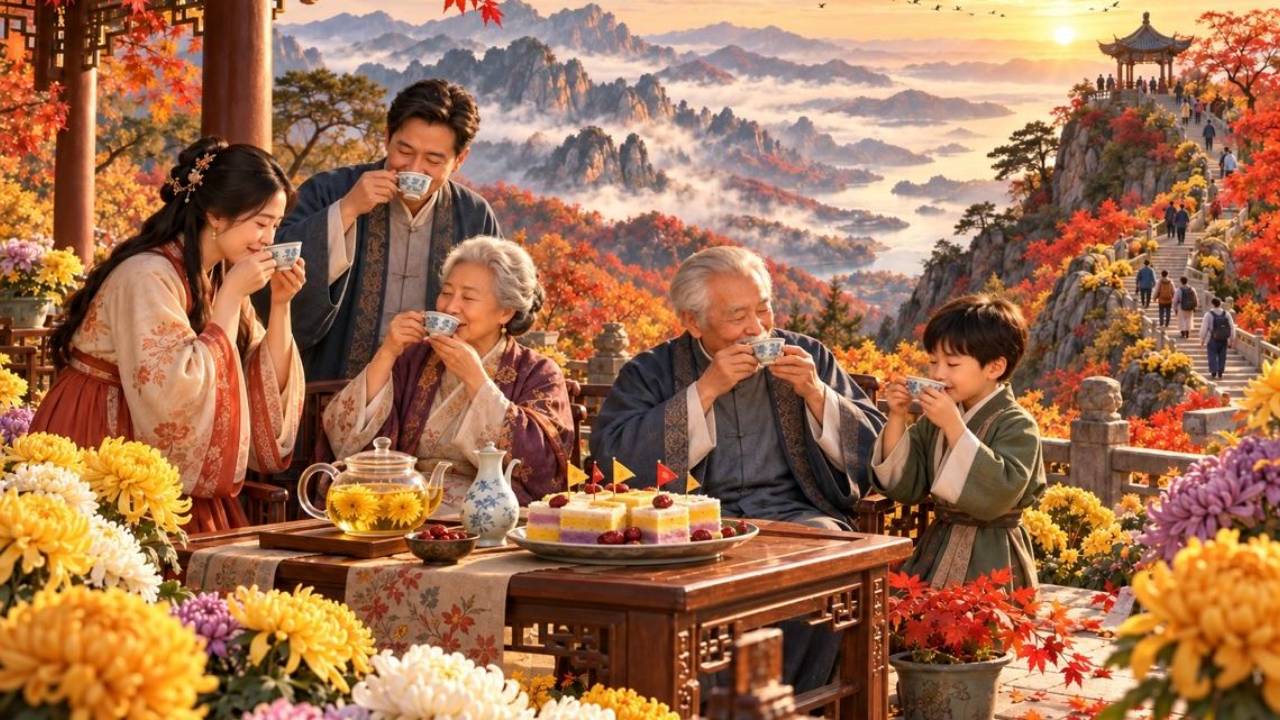
Oct 15, 2026On the ninth day of the ninth month of the Chinese lunar calendar, millions across East Asia climb hills and mountains, sip fragrant chrysanthemum tea or wine, and carry sprays of dogwood (cornelian cherry). Known as the Double Nine Festival or “Chong Yang Jie,” this ancient tradition represents far more than a simple autumn outing. It is a profound celebration rooted in the numerical cosmology of the Yi Jing (I Ching/Book of Changes) and the natural philosophy of early Taoism. To understand why the ninth day of the ninth month holds such importance, one must look to the Yi Jing, the foundational text of Chinese natural philosophy.
In Yi Jing cosmology, all phenomena in the universe are divided into two complementary forces:
Yin: Receptive, dark, cold, yielding, and represented numerically by even numbers (six being the ultimate Yin number).
Yang: Active, light, warm, creative, and represented numerically by odd numbers (nine being the ultimate Yang number).
Because 9 is the greatest single-digit odd number, it represents the apex of Yang energy.
When the ninth day coincides with the ninth lunar month, the two supreme Yang numbers converge, hence the name “Chong Yang,” which translates to “Double Yang” or “Repeated Yang.” In the dynamic view of the Yi Jing, extreme states naturally transform into their opposites. So, when Yang reaches its absolute maximum, it starts becoming unstable and runs the risk of sudden tipping or collapse into Yin. The Double Nine day was historically viewed with both reverence and caution: a moment of dangerous peak vitality demanding balance, mindfulness, and protective action before the cold Yin of winter takes hold.
Long before Taoism was developed into an institutionalized religion with communal rituals and religious hierarchies, it existed as a philosophical way of living, a philosophy articulated by Laozi in the Tao Te Ching and Zhuangzi. This original worldview emphasizes living in harmony with the Tao (the natural order or Way of the universe), practicing Wu Wei (effortless action), and observing the rhythm of natural cycles. The Double Nine Festival aligns naturally with early Taoist philosophy across four main dimensions. Early Taoist thinkers viewed humans as microcosms within the macrocosm of nature.
Autumn is the season of transition when nature's Yang begins to decline and Yin rises. By climbing to high altitudes, drinking purifying herbs, and spending time outdoors on the Double Nine, practitioners actively aligned their personal energy with the earth's seasonal retreat. Taoist philosophy focused heavily on the art of cultivating health, vital breath (Qi), and longevity through daily habits, herbs, and outdoor movement. Chrysanthemums are renowned in Chinese medicine and Taoist lore for their ability to cool internal heat, clear the mind, and promote longevity. Dogwood is a strong aromatic plant worn to repel pests, warm the body, and balance external cool dampness.
In the Zhuangzi, mountains are often used as metaphors for transcending narrow human perspectives and viewing things with clarity. Ascending high places on Double Nine reflects this philosophical idea of physically stepping out of valleys to gain expansive vision. While its philosophical roots stem from the Yi Jing, the popular narrative origins of the festival are recorded in Eastern Han dynasty folklore. According to legend, a deadly pestilence plagued the lands near the Ru River. A young man named Huan Jing sought out a wise mountain hermit named Fei Changfang to learn the secrets of natural wisdom and herbal medicine.
On the eighth day of the ninth month, the master warned Huan Jing, “Tomorrow, a disease will attack your village. Take your family, give each person a sachet of dogwood and a cup of chrysanthemum wine, and lead them to the highest mountain peak.” Huan Jing followed the instructions. From the mountain peak, his family remained safe while the pestilence passed through the valley below, absorbed by the family's livestock. From that day forward, climbing heights and consuming protective herbs on the ninth day became a universal ritual to ward off misfortune.
The Double Nine Festival stands as an ancient expression of early Chinese thought. By combining the numerical wisdom of the Yi Jing and the natural harmony of early Taoism, it serves as an autumn reminder to step outdoors, seek higher perspectives, honor those who came before us, and adjust our lives to the rhythm of nature.
Sign up for our mailing list!
Get monthly newsletters, updates, and Taoist cultivation resources delivered to your inbox.
We will never sell your information.
