Seasonal Guidance For Mid-Spring
Mar 19, 2026In this new monthly blog series, we will be offering Taoist perspectives on how to live in rhythm with the seasonal changes unfolding over the coming weeks.
The first thing to understand is that rather than treating Spring, Summer, Fall, and Winter as single blocks of time, the Chinese system tracks the year in shorter increments, based on careful observation of subtle but meaningful changes in light, climate, and living conditions. For this reason, the traditional Chinese calendar divides the year into 24 shorter seasonal periods, each lasting about two weeks.
These short periods have names such as Rain Water and Waking of Insects, reflecting what is happening in the natural world as the season unfolds. Together, they offer a precise and lived way of understanding seasonal change — one that has long shaped agriculture, daily rhythms, and seasonal awareness.
Taoism emerged in cultures where people lived closely with these rhythms. For Taoists, paying attention to seasonal change was not abstract or symbolic — it was practical. Just as animals instinctively adjust their behavior throughout the year, Taoist practitioners understood that human beings, too, thrive when they adapt their activity, nourishment, and inner life to the season they are actually in.
One of the clearest examples of how Taoists placed a strong emphasis on cultivating in harmony with the seasons is found in a book called Chen Tuan’s Four Seasons Internal Kung Fu, which Stuart translated. The text is primarily focused on Dao Yin exercises that shift according to the four main seasons, as well as each two-week seasonal period. It also includes recommendations for seasonal nutrition, herbal support, and lifestyle guidance. Video instruction of these practices can be found in the Nourishing Life Practices area of the membership.
March 20 – April 20: Mid-Spring
At this point in the Chinese seasonal calendar, Spring is no longer just beginning — it is fully underway.
The transitional quality of early Spring gives way to a more stable and expressive phase. Yang energy has now clearly risen. The environment reflects this shift: light is stronger, days are longer, and life is visibly expanding in all directions.
This period spans two solar terms: Spring Equinox (Chūnfēn) (~ March 20–April 4) and Clear and Bright (Qīngmíng) (~ April 5–April 20). Together, they describe the movement from balance into full expression — from equilibrium into growth.
Spring Equinox (Chūnfēn): Balance and Equalization
Spring Equinox marks a moment of precise balance in the year, when day and night are equal in length. Yin and Yang are momentarily in equilibrium before Yang continues its ascent.
Unlike early Spring, which is characterized by instability and fluctuation, this phase carries a greater sense of organization. Energy is no longer just stirring — it is distributing more evenly throughout the system.
In the body, this may register as increased clarity, steadier energy, and a greater capacity to act, though not yet at full intensity. There is often a sense of things coming online in a more coordinated way.
Emotionally, this period tends toward neutrality. The turbulence of early Spring settles, and perception becomes more even. Decisions are less reactive and more grounded.
The guidance during Spring Equinox is to support balance. Regulation is more appropriate than exertion. Align with the symmetry present in the environment rather than trying to accelerate beyond it.
Clear and Bright (Qīngmíng): Expansion and Visibility
As the season progresses, it moves into Clear and Bright (Qīngmíng), when the qualities of Spring become fully apparent.
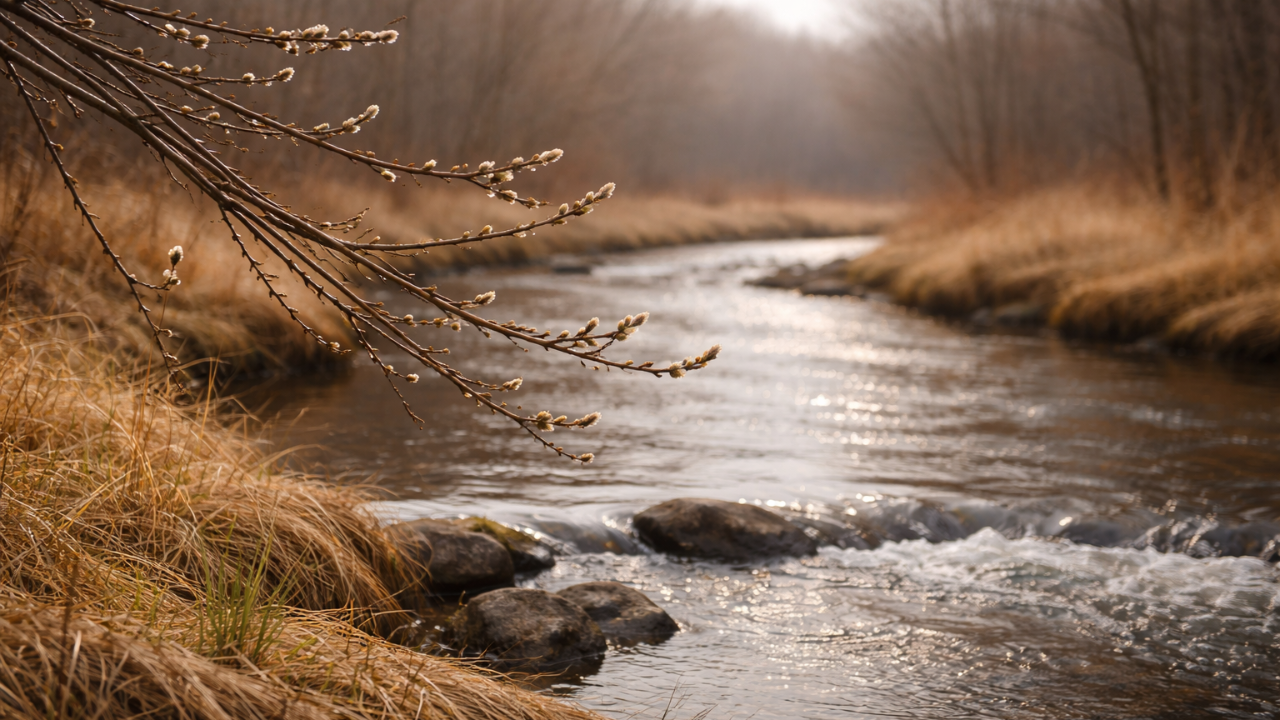
The air becomes clearer, the light stronger, and the signs of change more noticeable, even if growth is not yet fully visible. Branches begin to swell with buds, and the environment takes on a more active quality. What has been forming beneath the surface is beginning to move toward expression.
In the body, this often corresponds with increased vitality and a stronger impulse toward movement and engagement. Energy is more available and circulates with greater ease.
Emotionally, there is often a sense of openness and forward direction. The inclination to act, build, and participate becomes more pronounced.
At the same time, this increase in Yang introduces the possibility of excess. Without regulation, energy can become scattered, and activity can outpace capacity.
The guidance during Clear and Bright is to expand with clarity. Expression is appropriate, but it should remain organized and connected to the body’s actual condition.
Seasonal Guidance Across Both Periods
Across Spring Equinox and Clear and Bright, the governing principle is regulated expansion.
This is no longer the tentative emergence of early Spring. Movement and expression naturally emerge. But it should be structured enough to remain sustainable.
Rather than forcing growth, the emphasis is on allowing it and giving it form. Support what is already moving, and organize it so that it can continue without strain.
Food & Herbal Support
As Yang rises and activity increases, the Liver system remains central in coordinating movement and maintaining smooth internal flow.
In Chen Tuan’s Four Seasons Internal Kung Fu, Spring is consistently associated with supporting and regulating the Liver as the body transitions out of storage and into activity. The approach is not to force detoxification, but to assist the body in processing the natural increase in circulation without obstruction.
Traditional supports include milk thistle, Chinese red dates, and turmeric. These are used to improve liver function, protect against depletion, and assist in clearing what has accumulated during the Winter months. They are taken in moderate, steady amounts, supporting function rather than overriding it.
Green foods remain central during this period, reflecting Spring’s association with growth and renewal. Leafy vegetables — such as dandelion greens, arugula, mustard greens, and spinach — are especially appropriate. These are best taken lightly cooked, preserving their upward-moving quality while maintaining digestive stability.
Green tea is traditionally included for its cleansing properties, though in moderate amounts, as excess can tax the system. Fermented foods such as miso, often prepared as a warm soup with seaweed, are also used to support the body’s ability to process and eliminate what has accumulated.
As activity increases in mid-Spring, the body begins to shift how it processes and circulates energy. In Taoist and traditional Chinese medicine, this season is associated with the Liver, which is responsible for maintaining the smooth flow of Qi and helping the body process what has accumulated during the more inward, storage-oriented months of Winter. As this system becomes more active, it can also become more easily constrained if not supported.
During this time, you can begin to eat in a slightly lighter and more varied way, while still supporting smooth circulation and Liver function. Cooked greens, light broths, and moderate use of traditional supports such as green tea, turmeric, and Chinese red dates help promote movement and assist the body in clearing what is no longer needed. The aim is not to aggressively detox, but to support circulation, maintain clarity, and allow the body to adjust to increased activity without strain.
Lifestyle Guidance
This is a period for measured engagement with the external world.
Activity can increase. Work can move forward. Social and creative life can expand. These movements are consistent with the season.
As activity increases, it becomes even more important to maintain your center, and not let the energy scatter you or carry you away.
Spring Equinox establishes balance. Clear and Bright introduces expansion. Together, they form a progression of moving outward without losing internal regulation.
Rather than pursuing intensity, allow momentum to build at a rate the body can sustain. Action should arise from clarity, not urgency.
If early Spring required holding the tension between rest and movement, mid-Spring requires maintaining balance within movement itself.
This is the stage of the year where direction becomes visible and where what has been forming begins to take shape. The task is not to force that shape, but to support it so that it can develop without distortion.
—Lily
Sign up for our mailing list!
Get monthly newsletters, updates, and Taoist cultivation resources delivered to your inbox.
We will never sell your information.
