Madame Wei Huacun’s Birthday
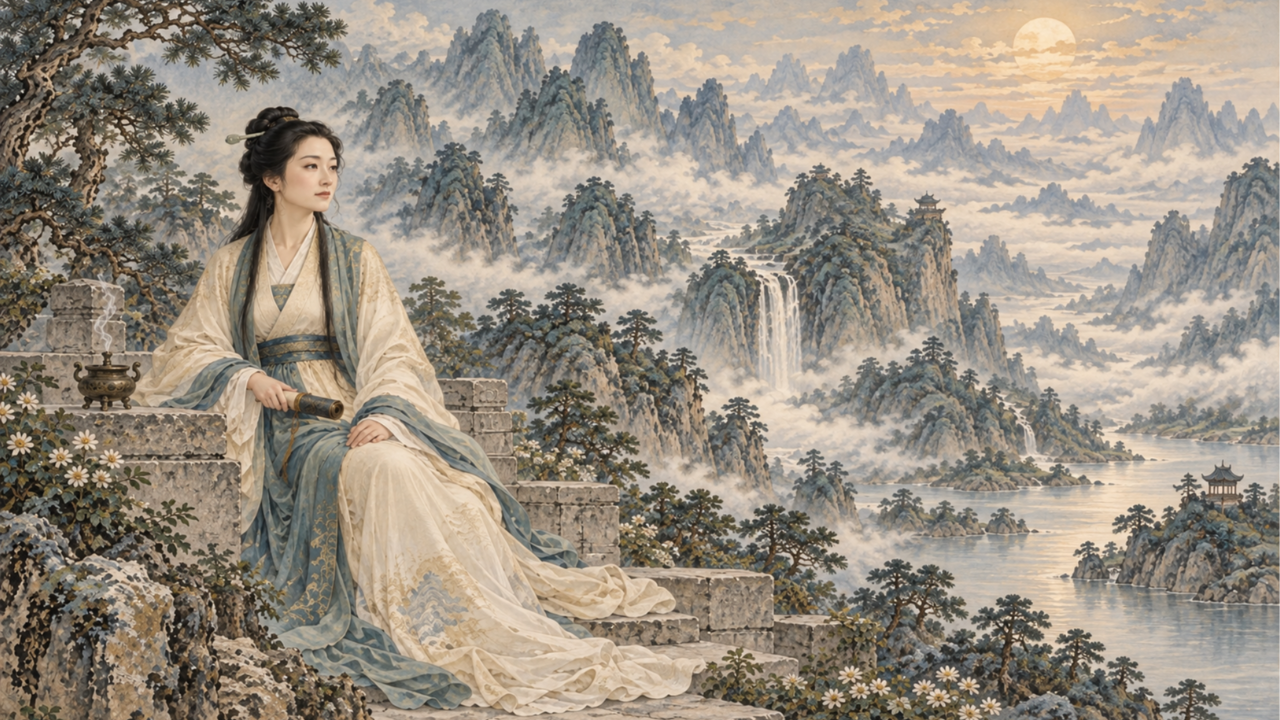
Oct 15, 2026Madame Wei Huacun is widely revered as the founder, matriarch, and first grand master of the Supreme Clarity (Shangqing) School of Taoism. Her teachings shifted the focus of Taoist practice away from external alchemy and communal rituals towards placing emphasis instead on solitary meditation, internal visualization, and spiritual transformation.
Chinese history distinguishes between two main aspects of Taoism. The first is often referred to as original Taoism, and this covers the deeply ancient time-period where people followed a way to live in harmony with the Tao (the natural order/source of the universe), well before it was even given the name “Taoism.” It was a philosophy and way to live that focused on practicing non-action, naturalness, and cultivating internal life force. It was not a religion, and returning to the primordial source was the ultimate goal for these masters of old.
The second main aspect of Taoism refers to organized, institutionalized Taoism, which began much later, in the 2nd century CE, with Zhang Daoling and the founding of the Way of the Celestial Masters. This shift introduced structured priesthoods, formal temples, scriptural canons, deity worship, talismans, external alchemy, and communal rituals. Traditional Chinese practitioners see both of these aspects as branches of the same tree.
Madame Wei Huacun was born in 252 CE in Rencheng, China (modern-day Shandong Province) to the wealthy and prominent Wei family. She was the daughter of a high-ranking official in the Jin Dynasty government. From a very young age, she read extensively, and being raised in an environment of classical learning, she mastered the Confucian Classics. Her true passion, however, was the Taoist philosophical and esoteric works of Laozi and Zhuangzi. Although her parents respected her intellect, they didn't support her desire to abandon worldly life. When she was 24, under parental pressure, societal obligations forced them to marry her off to a government official.
Madame Wei managed the household and gave birth to two sons. But desiring to live as a solitary mountain ascetic, once her sons grew older, she stepped back from social duties, withdrew into a secluded wing of the house, and dedicated herself to daily meditation, breath retention, and internal energy work. Her spiritual focus was recognized, and she was initiated into the Way of the Celestial Masters, eventually reaching the status of a Taoist priestess.
According to Shangqing lore, during her mid-to-late 30s, her spiritual dedication attracted transcendent immortals, including Master Wang Bao. They presented her with sacred talismans, esoteric keys to the Yellow Court Scripture, and methods for microscopic internal visualization. When war broke out, she fled south alongside her family. In the southern mountains, she lived as a hermit for over two decades. Free from domestic obligations, she refined the practices of solar/lunar light absorption, internal deity visualization, and energy circulation. She earned a reputation as a healer and master of spiritual arts, drawing in students until her passing in 334 CE at age 82.
Three decades after her death, Yang Xi, a highly educated scholar and spirit-medium, contacted her through visionary, nocturnal states. Rather than ecstatic bodily possession (where a spirit takes over a practitioner's body), Yang Xi engaged in trance dictation and automatic writing at Mount Mao. Yang Xi didn't act alone; he was employed as a spiritual advisor by an influential aristocratic family, the Xu family. The Xu family possessed strong ties to the Celestial Masters tradition and held physical custody of sacred scriptures and talismans that had belonged to Madame Wei herself.
Because Madame Wei was revered as a primary ancestor of these teachings, her spirit appeared as a divine guide to instruct Yang Xi and her former followers' descendants. From both a historical-critical and Taoist perspective, these revelations are considered exceptionally well documented and authentic. Unlike many ancient visions that rely on oral tradition, Yang Xi’s revelations left an extensive paper trail. She also dictated the foundational body of the Shangqing school, including the commentaries on the Internal Yellow Court Scripture.
Her life proved that household responsibilities and marriage were compatible with high spiritual attainment, establishing that women could serve as supreme spiritual masters and founders of entire schools of practice. What makes Madame Wei remarkable is that while she operated firmly within institutionalized religious Taoism, her teachings re-emphasized the personal, mystical internalization of early philosophical cultivation. Madame Wei’s Shangqing school brought the focus back to solitary, internal practice.
Instead of looking to external gods in high places, her techniques taught that all celestial “gods” and cosmic energies exist inside the practitioner's own body and mind. So while Madame Wei Huacun was a leader and saint of organized religious Taoism, her life's work helped ensure that deep, individual, internal cultivation remained the crux of it.
Sign up for our mailing list!
Get monthly newsletters, updates, and Taoist cultivation resources delivered to your inbox.
We will never sell your information.
