Liezi’s Celebration Day
Aug 13, 2026Liezi (or Lie Yukou 列子) is one of the three foundational masters of Taoism, along with Laozi and Zhuangzi. He occupied a unique space in Chinese thought, living during the Warring States/Hundred Schools of Thought period, and serving as a bridge between philosophical Taoism and early esoteric, mystical body-mind teachings.
Historically, details about Lie Yukou’s life are sparse. Because the Han dynasty historian Sima Qian omitted Liezi from his famous Records of the Grand Historian (Shiji), some 19th-century scholars questioned whether Liezi was a real person or a literary persona created by Zhuangzi. However, most modern historians agree that Lie Yukou was a genuine historical figure, though much of his persona became elevated into myth and legend over time.
The Liezi is often considered the most accessible and practical of the three major philosophical Taoist texts. It is filled with famous Chinese parables and fables, including a classic tale of persistence and natural alignment, known as “Foolish Old Man Removes the Mountain.”
“The Man from Qi Worried the Sky Would Fall” explores useless anxiety versus trusting the cosmic order, and “The Dream of King Mu of Zhou” questions the boundary between reality and hallucination.
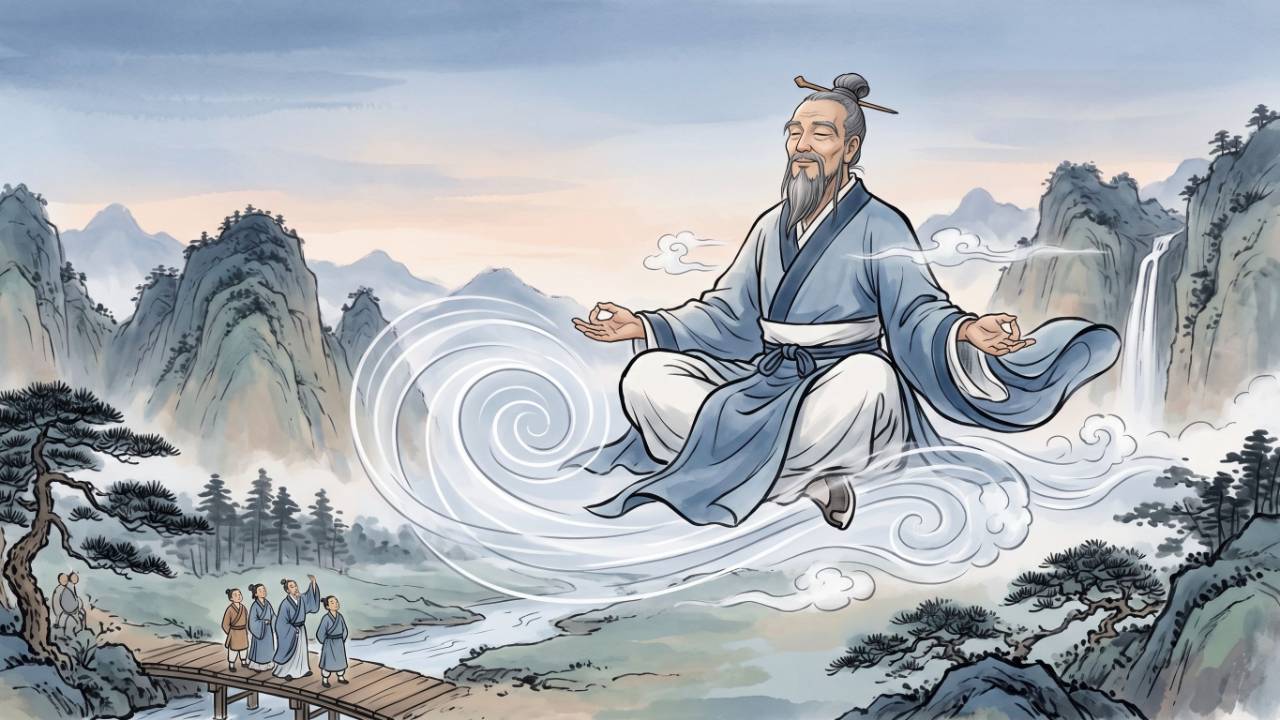
Liezi is heavily associated with deep Taoist esoteric practices, mystical cultivation, and supernatural phenomena. In the spectrum of Taoist history, Liezi represents the link between philosophical Taoism and practical Taoism, including shamanic spirit journeys and early internal cultivation. The most famous legend surrounding Liezi is his ability to “ride the wind.” In Chapter 2 of the Liezi (and referenced in the opening of the Zhuangzi), Liezi explains how he studied under Master Huazi and Master Lao Shang. He states:
“After nine years of practice, my mind ceased thinking of right and wrong, and my mouth stopped speaking of gain and loss … Internal and external became one. My eyes became like my ears, my ears like my nose, my nose like my mouth. My spirit concentrated and my physical body dissolved. I did not know what my feet were supported by, or what the wind was carrying. I was blown about like leaves falling from a tree, not knowing whether I was riding the wind or the wind was riding me.”
This state of physical levitation and lightness became a foundational archetype in Taoist Xian (Immortality) lore and martial/internal arts. In Taoist lore, Liezi’s “Riding the Wind” is the definitive story of spiritual release and physical transformation.
Found in Chapter 2, "The Yellow Emperor" of the Liezi, the parable details the exact, step-by-step process of training under his master, Old Shang, and how dissolving the ego boundary leads to effortless mastery over nature.
Before the systemization of Neidan (Internal Alchemy) in later centuries, early Taoists practiced foundational energy (Qi) regulation. Liezi’s teachings emphasize dissolving sensory fixation, entering a state where sensory boundaries collapse, allowing the practitioner’s internal Qi to merge directly with cosmic Qi.
Emptiness & Stillness: achieving absolute stillness so that the physical body loses its density and rigidity.
Precursor to breath control; Liezi's descriptions of harmonizing energy, mind, and spirit provided essential theoretical guides later adopted by Taoist internal alchemists (Neidan practitioners) and Qigong masters.
In the Liezi, advanced practitioners demonstrate control over physical matter: walking through fire without burning, swimming through violent whirlpools unharmed, and altering perception. In esoteric Taoism, these abilities are not viewed as magical tricks, but as the natural consequence of losing ego-awareness and becoming entirely non-resistant to the Tao. Liezi’s wind-riding isn’t about levitation tricks; it’s a spiritual principle: When you stop resisting the flow of reality, reality stops opposing you. By offering zero friction to the cosmos, you become light enough to move seamlessly with it.
Liezi occupies a unique place in Chinese tradition, as both a master storyteller of the Hundred Schools era and the archetypal shaman-sage whose teachings laid the foundation for Taoist internal cultivation, spirit flight, and meditative emptiness.
Sign up for our mailing list!
Get monthly newsletters, updates, and Taoist cultivation resources delivered to your inbox.
We will never sell your information.
