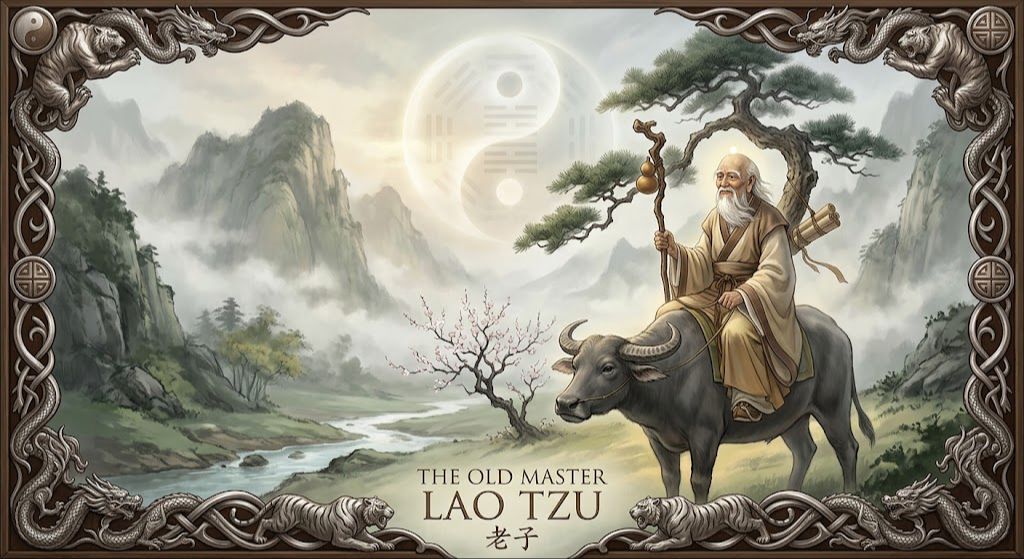
Lao Tzu’s Birthday (Lunar Day 15, 2nd Moon)
Mar 19, 2026You would be hard-pressed to try learning about Taoism and Taoist philosophy without any mention of Lao Tzu. Considered the founder of Taoism, his philosophical work, the “Tao De Jing,” is the foundational text and cornerstone of Taoist philosophy and its teachings and practices. This work explains the way of the universe and serves as a guide to the art of living, which follows this natural flow. Many well-known practices, such as Tai Chi, the study of the oracle known as the Yi Jing, Yin Yang, and Five Element theory (Wuxing), are based on or understood through a Taoist philosophical lens.
Lao Tzu’s birthday is observed on the 15th day of the 2nd moon. He is traditionally thought to have lived during the sixth century BCE, although there are many differing accounts, and his exact identity is shrouded in mystery and legend. Zhuangzi, another renowned foundational Taoist philosopher who lived during the 4th century BCE, talks about Lao Tzu and mentions the sage in many passages of his work, referring to him as a true master who had truly embodied the Tao.
The core teachings of Lao Tzu are the concepts of Wu Wei, or effortless action, and Wei Wu Wei, meaning action through non-action, which is about how to act while espousing that state to navigate life with minimal interference. Everything in the universe is constantly changing and transforming through the interplay of the universal forces of Yin (feminine and receptive) and Yang (masculine and active), creating a series of endless, cyclical movements. Lao Tzu considers the three treasures of Taoism to be compassion, moderation, and humility because they guide practitioners to be in harmony with the Tao and, as such, protect individuals from destructive outcomes.
If you’ve never read the Tao De Jing, it is truly a beautiful and insightful text that is essential for understanding Taoism’s core philosophy. Fascinatingly, it is a living document meant to be read repeatedly throughout a person’s life as its meaning changes, evolves, or deepens based on the reader's experiences.
You can pick up a copy of the Scripture on Tao and Virtue (Tao De Jing) by Stuart and me. This version includes the original Chinese text, an English translation by Stuart Alve Olson, and the Spanish by me, Suzanne J. Nosko.
Sign up for our mailing list!
Get monthly newsletters, updates, and Taoist cultivation resources delivered to your inbox.
We will never sell your information.
