Heavenly Worthies
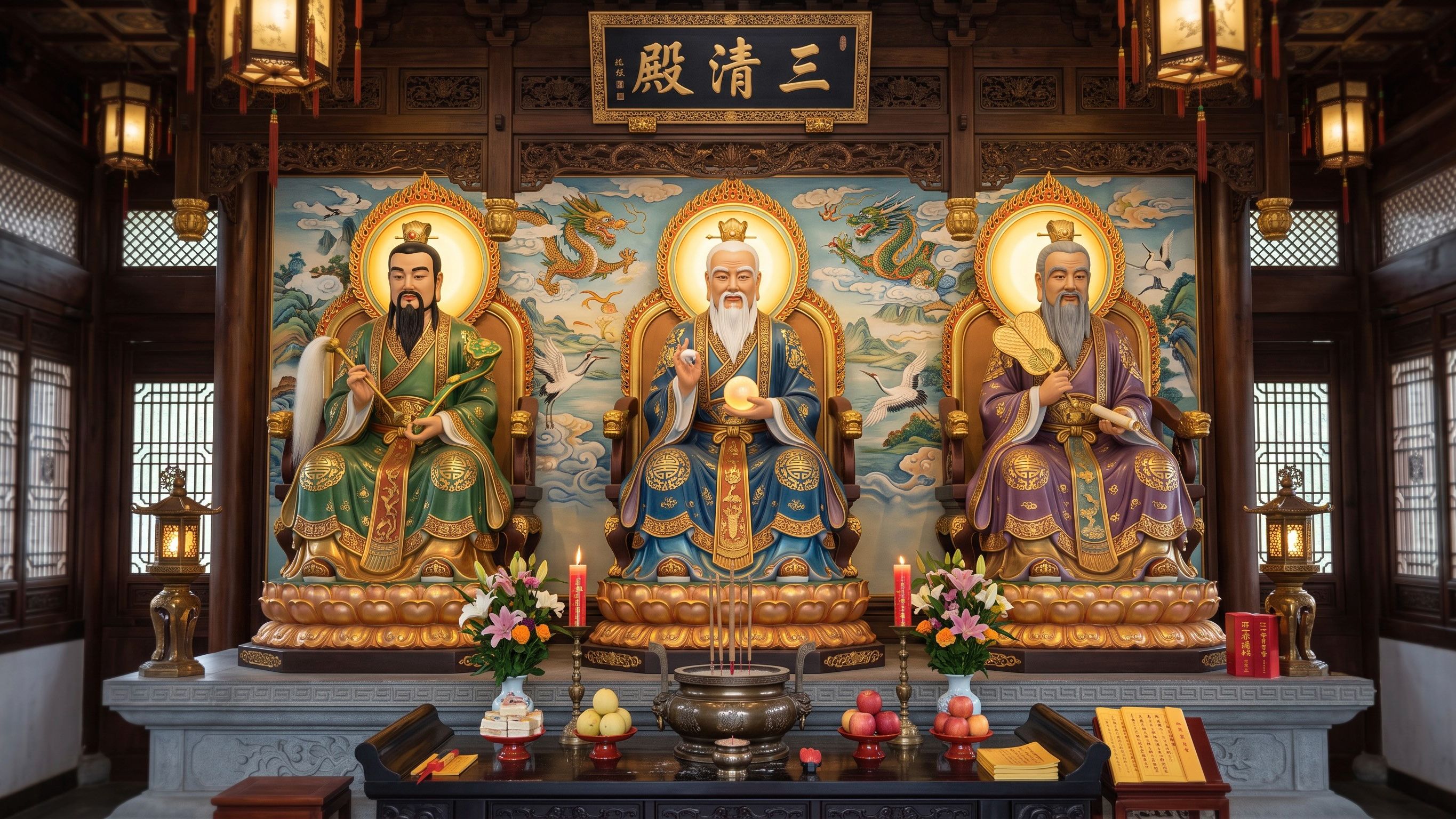
Jul 15, 2026The name “Heavenly Worthy” or “Tian Zun” isn't just one person; it’s actually a grand title used for any of the three deities collectively known as The Three Pure Ones.
The first Pure One is called Jade Pure One, and his formal name is Yuanshi Tianzun, the Heavenly Worthy of Primordial Beginning. He represents the first stage of cosmic creation, the undifferentiated primordial chaos before the universe was formed. He spontaneously emerged from the pure energy of the Tao.
The second Pure One is the Heavenly Worthy of Numinous Treasure, whose formal name is Lingbao Tianzun. He represents the second phase of creation. This is the moment the initial primordial energy began to separate into Yin and Yang, allowing form and order to emerge.
The last Pure One is Daode Tianzun, known as the Heavenly Worthy of the Way and Its Virtue. He represents the final stage of creation where the cosmos fully manifests into the myriad things.
The Three Pure Ones are the embodiment of this text. They are not competing gods, but rather three distinct emanations of the same ultimate Tao, though they are not the Tao itself, which is unnameable.
In chapter 42 of the Tao De Jing, it states:
“The Tao gave birth to the One. The One gave birth to the Two. The Two gave birth to the Three. The Three gave birth to the Ten Thousand Things.”
One could argue that this “trinity” resembles the trinity in Judeo-Christian religions, but while the structure looks identical, the underlying energies they're describing are actually built on two fundamentally different views of existence. If you look past the surface, the Judeo-Christian and Taoist models part ways on three major fronts.
The Judeo-Christian tradition didn’t start with abstract cosmic energies that they gradually turned into characters. It started with a very personal, active, talking God in the Hebrew Bible, and a historical man (Jesus) in the New Testament. The complex philosophy of the Christian Trinity was developed later (during the Councils of Nicaea and Constantinople) to try and explain how this historical man and his God were connected. Taoism started with the formless, impersonal, mechanical laws of nature. The “personification” actually happened centuries later when religious Taoism was made (Tianshi or Celestial Masters schools) to give everyday folk a visual deity to pray to, bow before, and ask for help.
The Judeo-Christian Trinity is an eternal relationship. Fundamentally, God is love, which requires a relationship. The Father loves the Son, the Son loves the Father, and the Holy Spirit is that literal bond of love. The Trinity exists so God can be a community of love within himself.
The Taoist trinity is a process of physics. The Three Pure Ones do not love each other, nor do they have a relational dynamic. They represent the laws of degeneration and regeneration, creation and expansion. The Tao is not loving in a human sense; it's impartial, like gravity.
They also differ on the goal for human beings. In Christianity, because God is a personal trinity, the ultimate goal of a human being is communion; to enter into a personal relationship with God.
In Taoism, because the trinity represents the flow of nature, the ultimate goal is alignment; to harmonize your own internal energy with the natural cycles of the universe (Wu Wei). While a Christian looks at a trinity and sees the ultimate expression of divine relationship, a Taoist looks at a trinity and sees the ultimate expression of cosmic cycles. One invites us into a divine family, while the other invites us into the natural rhythm of the cosmos.
Sign up for our mailing list!
Get monthly newsletters, updates, and Taoist cultivation resources delivered to your inbox.
We will never sell your information.
