Seasonal Guidance for Early Spring
Feb 17, 2026In this new monthly blog series, we will be offering Taoist perspectives on how to live in rhythm with the seasonal changes unfolding over the coming weeks.
The first thing to understand is that rather than treating Spring, Summer, Fall, and Winter as single blocks of time, the Chinese system tracks the year in shorter increments, based on careful observation of subtle but meaningful changes in light, climate, and living conditions. For this reason, the traditional Chinese calendar divides the year into 24 shorter seasonal periods, each lasting about two weeks.
These short periods have names such as Rain Water and Waking of Insects, reflecting what is happening in the natural world as the season unfolds. Together, they offer a precise and lived way of understanding seasonal change — one that has long shaped agriculture, daily rhythms, and seasonal awareness.
Taoism emerged in cultures where people lived closely with these rhythms. For Taoists, paying attention to seasonal change was not abstract or symbolic — it was practical. Just as animals instinctively adjust their behavior throughout the year, Taoist practitioners understood that human beings, too, thrive when they adapt their activity, nourishment, and inner life to the season they are actually in.
One of the clearest examples of how Taoists placed a strong emphasis on cultivating in harmony with the seasons is found in a book called Chen Tuan’s Four Seasons Internal Kung Fu, which Stuart translated. The text is primarily focused on Dao Yin exercises that shift according to the four main seasons, as well as each two-week seasonal period. It also includes recommendations for seasonal nutrition, herbal support, and lifestyle guidance. Video instruction of these practices can be found in the Nourishing Life Practices area of the membership.
February 17- March 20th: Early Spring
According to the Chinese calendar, Spring has already begun — even if, in much of the Western world, it still looks and feels very much like Winter. This can be surprising at first, especially if we’re used to thinking of seasons only in terms of weather. In Taoist understanding, seasons are not named by what is most visible on the surface, but by the direction life is beginning to move beneath it.
The earliest part of Spring is a transitional time. Yang has begun to rise, but cold and instability still linger, and the body has not yet fully regained its strength.
Spring officially begins with Lìchūn, the “Start of Spring” (~ Feb 3–17). This marks the energetic turning of the year, when the direction of movement shifts from inward to outward. Although Winter conditions often persist, Yang has already begun to stir beneath the surface. At this point in the season, that stirring is subtle and mostly internal.
As we reach the final days of Lìchūn, this shift is often felt more as restlessness or anticipation than as clear momentum. The outer world may appear dormant, but a time when things begin rearranging inside. In the body, this corresponds with the early awakening of Liver activity.
As the first lunar cycle after the New Year continues, we move out of Lìchūn and fully into Yǔshuǐ, or “Rain Water” (~ Feb 18–Mar 4). and gradually approach Jīngzhé, the “Waking of Insects” (~March 5 to March 20).
Together, these short seasonal periods describe a progression from subtle internal stirring into the first signs of visible movement and emergence.
Rain Water (Yǔshuǐ): Softening and Return of Flow
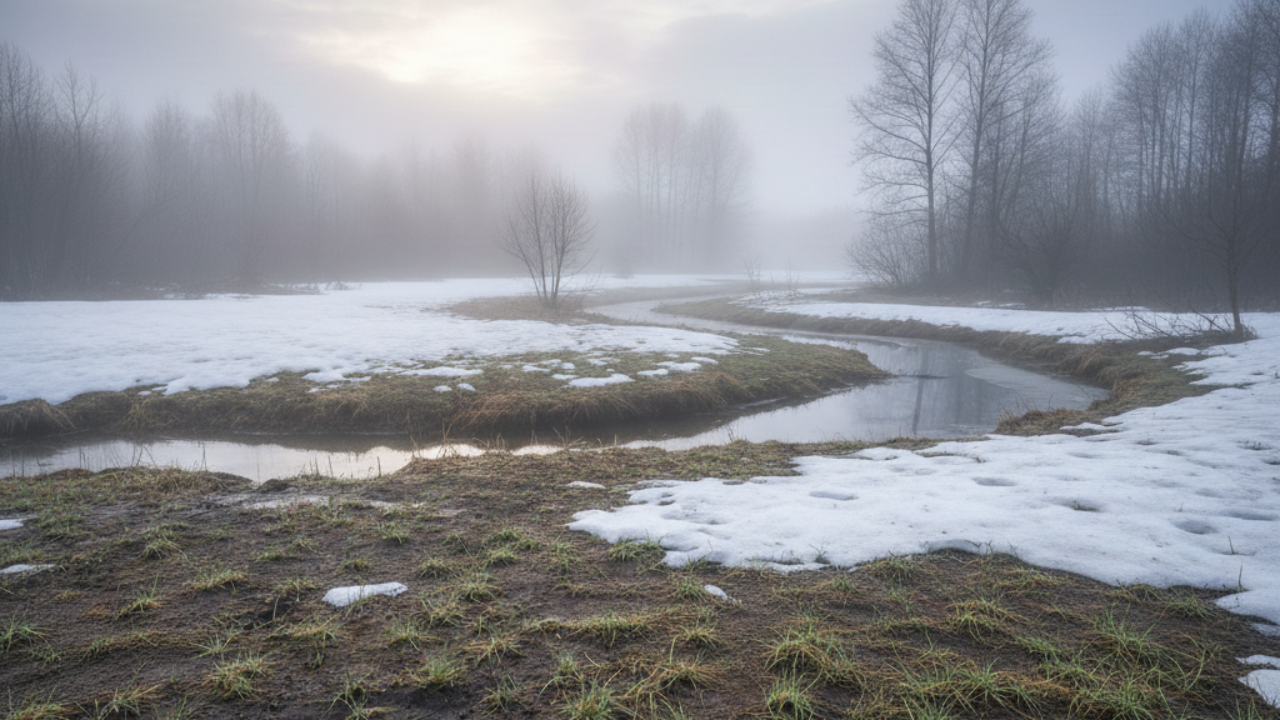
Rain Water marks the point when Spring becomes more tangible in daily life. Ice begins to melt, snow turns to rain, and what was frozen starts to loosen and flow. In the body, this often shows up as a growing sense of movement and activity returning, though strength and stamina are not yet fully restored.
This phase carries a quality of thawing rather than emergence. Energy begins to move again, but it does so unevenly. The guidance during Rain Water is to encourage movement and flow, and ease blockages, without forcing change or draining too much energy while the body is still emerging from Winter.
Emotionally, Rain Water can feel tender. Feelings may surface as things begin to soften, and many people experience a sense of being “in between” — no longer in deep Winter, but not yet ready for full outward action. This is normal. Nothing needs to be rushed.
Waking of Insects (Jīngzhé): Emergence and Stirring
As the month continues, it moves into Waking of Insects (Jīngzhé) (~ Mar 5–20). This marks the next shift in early Spring, when dormant life begins to stir more visibly. Plants push upward, insects awaken, and the urge toward expression, activity, and engagement grows stronger.
Compared to Rain Water, this period carries more outward momentum. What was thawing internally begins to show itself on the surface. There is often more clarity around what wants to move, change, or take form — though energy and resilience may still lag behind desire.
Because this month spans both Rain Water and Waking of Insects, it often brings mixed signals: a desire to stay protected and incubate longer, alongside a growing urge to express, create, and explore outwardly.
Taoist seasonal wisdom does not ask us to resolve this tension too quickly. Not retreating completely. Not charging ahead. Allowing both impulses to coexist, and letting clarity arise in time as you hold the tension. This as the natural rhythm of early Spring.
Seasonal Guidance Across Both Periods
Across both Rain Water and Waking of Insects, the overarching principle is gradual increase — allowing movement to build without tipping into depletion. This is not a month for extremes, but for pacing.
Food & Herbal Support
In Chen Tuan’s Four Seasons Internal Kungfu, particular care is given to supporting the Liver during early Spring, as movement resumes after a season of storage. The Liver plays a key role in coordinating circulation and processing what enters the body, and is especially sensitive during this transition.
Food and herbal recommendations during this period are supportive and restorative rather than intense, and apply across both short seasons.
Traditional supports include milk thistle, Chinese red dates, and turmeric, all used to strengthen and protect the Liver as activity increases. These are not meant to push the body, but to help it adapt smoothly to the return of movement.
Green foods also become appropriate during this time, reflecting Spring’s association with growth and renewal. Leafy green vegetables, taken cooked rather than raw, support circulation while remaining gentle on digestion. Green tea, used in modest amounts, is traditionally included to support the body’s natural processing without excess. Fermented foods such as miso, often prepared with seaweed as soup, are also highlighted as nourishing supports during this transitional phase.
One simple way to bring these principles together is through warm broths with greens — meals that carry Spring’s green, living quality while maintaining the warmth still needed as the body finishes emerging from Winter.
Lifestyle Guidance
This is not a time to retreat completely, nor a time to charge ahead. Across both short seasons, the guidance is to hold the tension between staying protected and beginning to move outward.
Allow both impulses to coexist. Let activity increase gradually. Let clarity arise in time as you hold the tension between the two. Early spring is the time to let direction reveal itself.
Sign up for our mailing list!
Get monthly newsletters, updates, and Taoist cultivation resources delivered to your inbox.
We will never sell your information.
